Recommended citation
ICRP, 2020. Paediatric Computational Reference Phantoms. ICRP Publication 143. Ann. ICRP 49(1).
Authors on behalf of ICRP
W.E. Bolch, K. Eckerman, A. Endo, J.G.S. Hunt, D.W. Jokisch, C.H. Kim, K-P. Kim, C. Lee, J. Li, N. Petoussi-Henss, T. Sato, H. Schlattl, Y.S. Yeom, M. Zankl
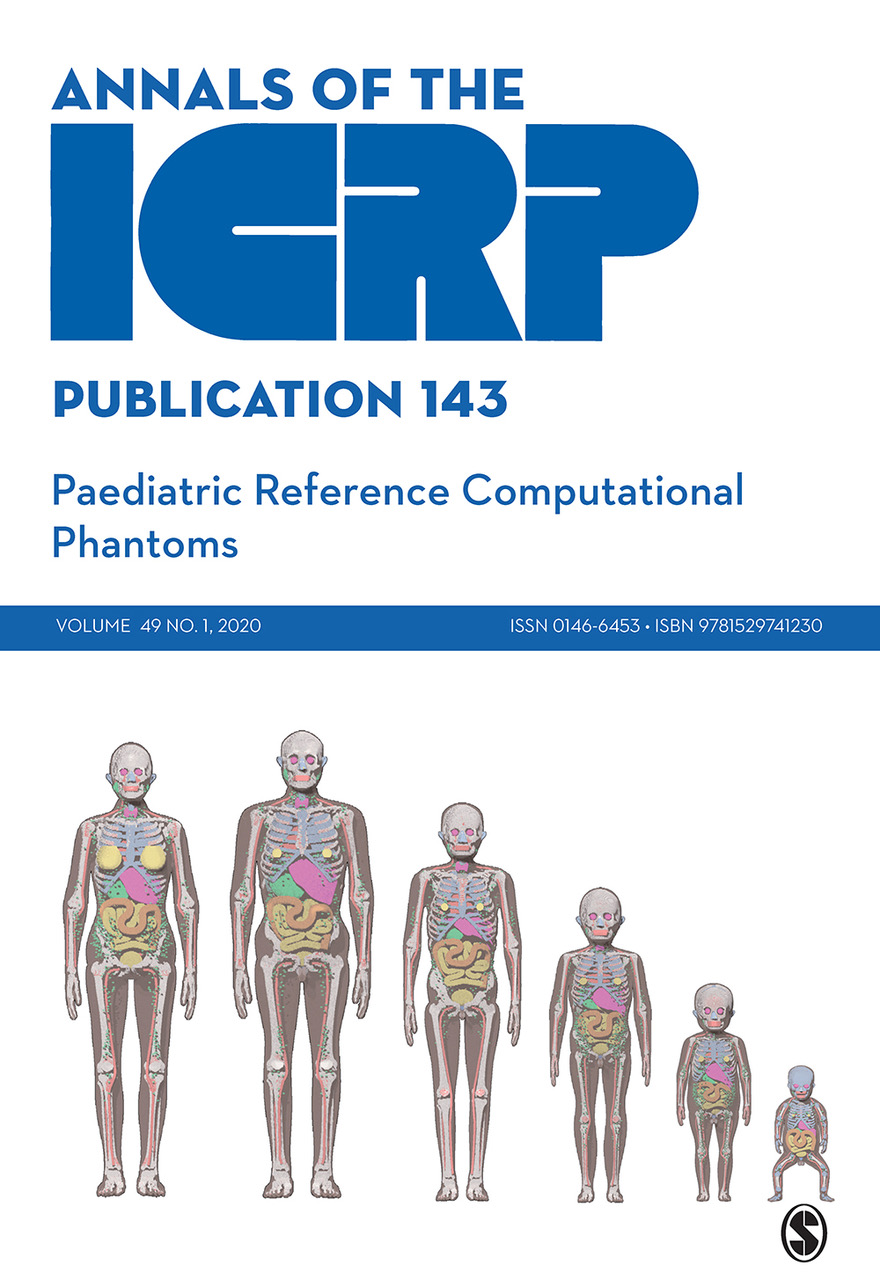
Abstract - This publication describes the development and intended use of a series of 10 computational phantoms representing Reference Male and Female at birth (newborn), 1 year, 5 years, 10 years, and 15 years of age, as defined in ICRP Publication 89. These phantoms have been formally adopted by the International Commission on Radiological Protection (ICRP) for use within ICRP Committee 2 in the development of age-dependent dose coefficients following the 2007 Recommendations (ICRP Publication 103). They are presented in this publication in the very same voxelised structures and tissue identification (ID) numbers as given in ICRP Publication 110 for the adult reference computational phantoms. These paediatric phantoms have been used by Task Group 90 of ICRP Committee 2 in the development of age-dependent dose coefficients representing external exposures to contaminated air, water, and soil. They have also been used by Task Group 95 of ICRP Committee 2 in the development of age-dependent specific absorbed fractions (SAFs) for internally emitted photons, electrons, alpha particles, and neutrons, in a manner similar to the SAF values for the adult given in ICRP Publication 133. These age-dependent SAF values are currently being utilised by Task Group 96 in the preparation of age-dependent dose coefficients for radionuclide ingestion and inhalation as part of the forthcoming Environmental Intakes of Radionuclides publication series which will update the dose coefficients of ICRP Publications 56, 67, 71, and 72.
Section 1 summarises the main reasons for constructing these phantoms – voxel phantoms that comply with the reference anatomical characteristics of the non-adult reference individuals presented in ICRP Publication 89. Section 2 reviews the body size/shape and organ-specific specifications of the ICRP paediatric reference phantoms. Section 3 presents, in detail, the methods of their construction, which includes nine steps in their development: (1) selection of computed tomographic (CT) data; (2) segmentation of those CT images; (3) body contour and organ modelling via non-uniform rational basis spline (NURBS)/polygon mesh (PM) surfaces; (4) adjustments of outer body contour to match total body mass; (5) adjustments of individual organ values to match reference masses; (6) subdivision of the skeletal tissues; (7) voxelisation of the NURBS/PM surfaces; (8) voxel retagging for lymphatic nodes and skeletal muscle; and (9) further modifications to bring the series of paediatric phantoms into a structure identical to that originally established for the adult phantoms of ICRP Publication 110. Section 4 follows with a description of the ICRP paediatric reference phantoms, including their main characteristics, skeletal source/target regions, regional blood distribution, and phantom limitations.
The publication is supported by a series of annexes. Annex A provides details on tissue ID numbers, tissue media, mass densities, and organ locations by both coordinate position and voxel count. Annex B provides a complete list of the various age-dependent and gender-dependent tissue media, their phantom masses, and elemental compositions. Annexes C and D provide a listing of all source and target regions, respectively, needed for internal as well as external dosimetric applications. Annexes E and F provide depth distributions and organ pair distance distributions, respectively, in a manner similar to that provided in ICRP Publication 110 for the adult phantoms. Annex G provides cross-sectional images – sagittal, coronal, and transverse planes. Finally, Annex H gives a description of the electronic files available for download and use of each of the 10 paediatric reference computational phantoms.
© 2020 ICRP. Published by SAGE.
Keywords: Computational phantoms; Voxel models; Paediatric reference individuals.
Key Points: Not included in this publication
Executive Summary: Not included in this publication
Concise Summary
The International Commission for Radiological Protection (ICRP) introduced paediatric phantoms representing Reference Males and Females at various ages, complementing their adult counterparts. The phantoms are modified from digital, medical images of real humans with modest adjustments made to conform with ICRP definitions of the reference individuals. The phantoms define organ and tissue geometries required for dosimetry calculations. The purpose of the phantoms is to serve as the medium for simulations of radiation transport and the computation of age-dependent dose coefficients for external and internal exposures. The voxel phantoms of Publications 110 and 143 support the dosimetric quantities ICRP produces consistent with the Publication 103 System of Radiological Protection. While the adult phantoms alone can support radiation protection of workers, the paediatric phantoms, along with the adult, support radiation protection of members of the public and medical patient. In addition to the document containing details on the phantoms, the digital phantoms are freely available as an electronic download.
General Summary
Rational
The International Commission on Radiological Protection (ICRP) introduced adult voxel phantoms in 2009, which was a critical tool needed for computing occupational dose coefficients. Building upon this foundation, the ICRP has expanded its series with the introduction of 10 paediatric phantoms, covering age groups of two sexes from birth to 15 years. These digital, geometrical models subsequently support the computation of dose coefficients for a variety of external and internal exposures thereby supporting the protection of members of the public and medical patients.
Construction Methodology of the Paediatric Reference Phantoms
The paediatric reference phantoms were developed to model the complex geometries of human tissue regions, necessary for radiation dose computations. The development process for these paediatric phantoms involve several steps, starting with Computed Tomography (CT) selection, manual segmentation of tissue regions, methods for smoothing surface regions, adjustments to conform with ICRP reference masses, and voxelization. The resulting 3-D voxel arrays have a higher resolution than their adult counterparts. The skeleton is subdivided into cortical bone, trabecular spongiosa, and medullary cavities. Microscopic regions of the alimentary tract, respiratory tract, and skeleton are not defined in the phantoms, requiring additional models for Specific Absorbed Fraction (SAF) derivations to support the computation of internal dose coefficients.
The voxel phantoms of Publications 110 and 143 support the dosimetric quantities ICRP produces consistent with the Publication 103 System of Radiological Protection. The ICRP plans to publish dose coefficients for various external and internal exposures. The publication includes crucial details in annexes, offering information on tissue ID numbers, media, mass densities, and organ locations. These annexes delve into age and sex-dependent tissue media, phantom masses, and elemental compositions. In addition to these published methods and details, the digital phantoms are freely available as an electronic download accompanying this publication. This comprehensive document aims to facilitate the understanding and application of paediatric reference computational phantoms, emphasizing the meticulous development process, detailed specifications, and the potential applications in advancing radiological protection and dosimetry across various age groups.
Technical Summary
Rational and Objectives
In 2009, the International Commission for Radiological Protection (ICRP) introduced adult voxel phantoms (Publication 110), which was crucial for the assessment of occupational exposure. These phantoms, derived from real medical data, maintained anatomical fidelity as outlined in Publication 89. The phantoms were used by multiple Committee 2 Task Groups to compute occuptational dose coefficients for diverse radiation fields. This Publication extended the series to include 10 computational phantoms representing Reference Males and Females at birth (newborn), 1 year, 5 years, 10 years, and 15 years of age. These new phantoms were utilized in Committee 2 tasks, including establishing dose coefficients for localized radionuclides, and updating environmental intake dose coefficients for all age groups. An extension of Publication 133 covers age-dependent specific absorbed fraction (SAF) values for photons, electrons, alpha particles, and internal neutrons in the ICRP paediatric phantom series. The publication provides information about the ICRP paediatric reference phantoms including:
This publication describes the development and intended use of a series of 10 computational phantoms representing Reference Male and Female at birth (newborn), 1 year, 5 years, 10 years, and 15 years of age, as defined in ICRP Publication 89. These phantoms have been formally adopted by the International Commission on Radiological Protection (ICRP) for use within ICRP Committee 2 in the development of age-dependent dose coefficients following the 2007 Recommendations (ICRP Publication 103). They are presented in this publication in the very same voxelised structures and tissue identification (ID) numbers as given in ICRP Publication 110 for the adult reference computational phantoms. These paediatric phantoms have been used by Task Group 90 of ICRP Committee 2 in the development of age-dependent dose coefficients representing external exposures to contaminated air, water, and soil. They have also been used by Task Group 95 of ICRP Committee 2 in the development of age-dependent specific absorbed fractions (SAFs) for internally emitted photons, electrons, alpha particles, and neutrons, in a manner similar to the SAF values for the adult given in ICRP Publication 133. These age-dependent SAF values are currently being utilised by Task Group 96 in the preparation of age-dependent dose coefficients for radionuclide ingestion and inhalation as part of the forthcoming Environmental Intakes of Radionuclides publication series which will update the dose coefficients of ICRP Publications 56, 67, 71, and 72.
Section 1 summarises the main reasons for constructing these phantoms – voxel phantoms that comply with the reference anatomical characteristics of the nonadult reference individuals presented in ICRP Publication 89. Section 2 reviews the body size/shape and organ-specific specifications of the ICRP paediatric reference phantoms. Section 3 presents, in detail, the methods of their construction, which includes nine steps in their development: (1) selection of computed tomographic (CT) data; (2) segmentation of those CT images; (3) body contour and organ modelling via non-uniform rational basis spline (NURBS)/polygon mesh (PM) surfaces; (4) adjustments of outer body contour to match total body mass; (5) adjustments of individual organ values to match reference masses; (6) subdivision of the skeletal tissues; (7) voxelisation of the NURBS/PM surfaces; (8) voxel retagging for
9 lymphatic nodes and skeletal muscle; and (9) further modifications to bring the series of paediatric phantoms into a structure identical to that originally established for the adult phantoms of ICRP Publication 110. Section 4 follows with a description of the ICRP paediatric reference phantoms, including their main characteristics, skeletal source/target regions, regional blood distribution, and phantom limitations.
The publication is supported by a series of annexes. Annex A provides details on tissue ID numbers, tissue media, mass densities, and organ locations by both coordinate position and voxel count. Annex B provides a complete list of the various age dependent and gender-dependent tissue media, their phantom masses, and elemental compositions. Annexes C and D provide a listing of all source and target regions, respectively, needed for internal as well as external dosimetric applications. Annexes E and F provide depth distributions and organ pair distance distributions, respectively, in a manner similar to that provided in ICRP Publication 110 for the adult phantoms. Annex G provides cross-sectional images – sagittal, coronal, and transverse planes. Finally, Annex H gives a description of the electronic files available for download and use of each of the 10 paediatric reference computational phantoms.
The ICRP paediatric reference phantoms consist of 3-D voxel arrays, adhering to a defined orientation convention similar to adult reference phantoms. The voxel resolution, count, and matrix size for each paediatric phantom aim for approximately 55 million voxels. Notably, higher resolution distinguishes these paediatric phantoms from their adult counterparts in Publication 110.
The skeleton is subdivided into cortical bone, trabecular spongiosa, and medullary cavities. Microscopic regions of the alimentary tract, respiratory tract, and skeleton are not defined in the phantoms, requiring additional models for Specific Absorbed Fraction (SAF) derivations to support the computation of internal dose coefficients.
The described paediatric reference phantoms, comprising a 10-member series, serve as official computational models for deriving dose coefficients from exposure to ionizing radiations. Derived from CT data, these 3-D representations enable calculations of organ and tissue equivalent dose, as well as effective dose. The ICRP plans to publish recommended dose coefficients for various exposures for internal exposures and dose coefficients for external radiation fields. Its important to note that since these phantoms are based on definitions of theoretical reference individuals, their purpose is for computing doses to the same reference individuals upon which the current System of Radiological Protection relies. The reference phantoms may have some use in attempts to perform individualised dosimetry, but the user should do so understanding the inherent limitations and uncertainties.
Annex A includes information on tissue ID numbers, media, mass densities, and organ locations. Annex B lists age and gender-dependent tissue media, phantom masses, and elemental compositions. Annexes C and D detail source and target regions for internal and external dosimetric applications. Annexes E and F provide depth and organ pair distance distributions. Annex G offers cross-sectional images, and Annex H describes downloadable electronic files for each of the 10 paediatric reference computational phantoms. Published in 2020 by SAGE, endorsed by ICRP.
ICRP, 2020. Paediatric Computational Reference Phantoms. ICRP Publication 143. Ann. ICRP 49(1).
Authors on behalf of ICRP
W.E. Bolch, K. Eckerman, A. Endo, J.G.S. Hunt, D.W. Jokisch, C.H. Kim, K-P. Kim, C. Lee, J. Li, N. Petoussi-Henss, T. Sato, H. Schlattl, Y.S. Yeom, M. Zankl
Abstract - This publication describes the development and intended use of a series of 10 computational phantoms representing Reference Male and Female at birth (newborn), 1 year, 5 years, 10 years, and 15 years of age, as defined in ICRP Publication 89. These phantoms have been formally adopted by the International Commission on Radiological Protection (ICRP) for use within ICRP Committee 2 in the development of age-dependent dose coefficients following the 2007 Recommendations (ICRP Publication 103). They are presented in this publication in the very same voxelised structures and tissue identification (ID) numbers as given in ICRP Publication 110 for the adult reference computational phantoms. These paediatric phantoms have been used by Task Group 90 of ICRP Committee 2 in the development of age-dependent dose coefficients representing external exposures to contaminated air, water, and soil. They have also been used by Task Group 95 of ICRP Committee 2 in the development of age-dependent specific absorbed fractions (SAFs) for internally emitted photons, electrons, alpha particles, and neutrons, in a manner similar to the SAF values for the adult given in ICRP Publication 133. These age-dependent SAF values are currently being utilised by Task Group 96 in the preparation of age-dependent dose coefficients for radionuclide ingestion and inhalation as part of the forthcoming Environmental Intakes of Radionuclides publication series which will update the dose coefficients of ICRP Publications 56, 67, 71, and 72.
Section 1 summarises the main reasons for constructing these phantoms – voxel phantoms that comply with the reference anatomical characteristics of the non-adult reference individuals presented in ICRP Publication 89. Section 2 reviews the body size/shape and organ-specific specifications of the ICRP paediatric reference phantoms. Section 3 presents, in detail, the methods of their construction, which includes nine steps in their development: (1) selection of computed tomographic (CT) data; (2) segmentation of those CT images; (3) body contour and organ modelling via non-uniform rational basis spline (NURBS)/polygon mesh (PM) surfaces; (4) adjustments of outer body contour to match total body mass; (5) adjustments of individual organ values to match reference masses; (6) subdivision of the skeletal tissues; (7) voxelisation of the NURBS/PM surfaces; (8) voxel retagging for lymphatic nodes and skeletal muscle; and (9) further modifications to bring the series of paediatric phantoms into a structure identical to that originally established for the adult phantoms of ICRP Publication 110. Section 4 follows with a description of the ICRP paediatric reference phantoms, including their main characteristics, skeletal source/target regions, regional blood distribution, and phantom limitations.
The publication is supported by a series of annexes. Annex A provides details on tissue ID numbers, tissue media, mass densities, and organ locations by both coordinate position and voxel count. Annex B provides a complete list of the various age-dependent and gender-dependent tissue media, their phantom masses, and elemental compositions. Annexes C and D provide a listing of all source and target regions, respectively, needed for internal as well as external dosimetric applications. Annexes E and F provide depth distributions and organ pair distance distributions, respectively, in a manner similar to that provided in ICRP Publication 110 for the adult phantoms. Annex G provides cross-sectional images – sagittal, coronal, and transverse planes. Finally, Annex H gives a description of the electronic files available for download and use of each of the 10 paediatric reference computational phantoms.
© 2020 ICRP. Published by SAGE.
Keywords: Computational phantoms; Voxel models; Paediatric reference individuals.
Key Points: Not included in this publication
Executive Summary: Not included in this publication
Concise Summary
The International Commission for Radiological Protection (ICRP) introduced paediatric phantoms representing Reference Males and Females at various ages, complementing their adult counterparts. The phantoms are modified from digital, medical images of real humans with modest adjustments made to conform with ICRP definitions of the reference individuals. The phantoms define organ and tissue geometries required for dosimetry calculations. The purpose of the phantoms is to serve as the medium for simulations of radiation transport and the computation of age-dependent dose coefficients for external and internal exposures. The voxel phantoms of Publications 110 and 143 support the dosimetric quantities ICRP produces consistent with the Publication 103 System of Radiological Protection. While the adult phantoms alone can support radiation protection of workers, the paediatric phantoms, along with the adult, support radiation protection of members of the public and medical patient. In addition to the document containing details on the phantoms, the digital phantoms are freely available as an electronic download.
General Summary
Rational
The International Commission on Radiological Protection (ICRP) introduced adult voxel phantoms in 2009, which was a critical tool needed for computing occupational dose coefficients. Building upon this foundation, the ICRP has expanded its series with the introduction of 10 paediatric phantoms, covering age groups of two sexes from birth to 15 years. These digital, geometrical models subsequently support the computation of dose coefficients for a variety of external and internal exposures thereby supporting the protection of members of the public and medical patients.
Construction Methodology of the Paediatric Reference Phantoms
The paediatric reference phantoms were developed to model the complex geometries of human tissue regions, necessary for radiation dose computations. The development process for these paediatric phantoms involve several steps, starting with Computed Tomography (CT) selection, manual segmentation of tissue regions, methods for smoothing surface regions, adjustments to conform with ICRP reference masses, and voxelization. The resulting 3-D voxel arrays have a higher resolution than their adult counterparts. The skeleton is subdivided into cortical bone, trabecular spongiosa, and medullary cavities. Microscopic regions of the alimentary tract, respiratory tract, and skeleton are not defined in the phantoms, requiring additional models for Specific Absorbed Fraction (SAF) derivations to support the computation of internal dose coefficients.
The voxel phantoms of Publications 110 and 143 support the dosimetric quantities ICRP produces consistent with the Publication 103 System of Radiological Protection. The ICRP plans to publish dose coefficients for various external and internal exposures. The publication includes crucial details in annexes, offering information on tissue ID numbers, media, mass densities, and organ locations. These annexes delve into age and sex-dependent tissue media, phantom masses, and elemental compositions. In addition to these published methods and details, the digital phantoms are freely available as an electronic download accompanying this publication. This comprehensive document aims to facilitate the understanding and application of paediatric reference computational phantoms, emphasizing the meticulous development process, detailed specifications, and the potential applications in advancing radiological protection and dosimetry across various age groups.
Technical Summary
In 2009, the International Commission for Radiological Protection (ICRP) introduced adult voxel phantoms (Publication 110), which was crucial for the assessment of occupational exposure. These phantoms, derived from real medical data, maintained anatomical fidelity as outlined in Publication 89. The phantoms were used by multiple Committee 2 Task Groups to compute occuptational dose coefficients for diverse radiation fields. This Publication extended the series to include 10 computational phantoms representing Reference Males and Females at birth (newborn), 1 year, 5 years, 10 years, and 15 years of age. These new phantoms were utilized in Committee 2 tasks, including establishing dose coefficients for localized radionuclides, and updating environmental intake dose coefficients for all age groups. An extension of Publication 133 covers age-dependent specific absorbed fraction (SAF) values for photons, electrons, alpha particles, and internal neutrons in the ICRP paediatric phantom series. The publication provides information about the ICRP paediatric reference phantoms including:
- Body size, shape, and organ specifications of ICRP paediatric reference phantoms.
- Elaborations on construction methods involving CT data selection, segmentation, NURBS/ polygon mesh (PM) surfaces, and adjustments.
- Description of phantoms, covering characteristics, skeletal regions, blood distribution, and limitations.
This publication describes the development and intended use of a series of 10 computational phantoms representing Reference Male and Female at birth (newborn), 1 year, 5 years, 10 years, and 15 years of age, as defined in ICRP Publication 89. These phantoms have been formally adopted by the International Commission on Radiological Protection (ICRP) for use within ICRP Committee 2 in the development of age-dependent dose coefficients following the 2007 Recommendations (ICRP Publication 103). They are presented in this publication in the very same voxelised structures and tissue identification (ID) numbers as given in ICRP Publication 110 for the adult reference computational phantoms. These paediatric phantoms have been used by Task Group 90 of ICRP Committee 2 in the development of age-dependent dose coefficients representing external exposures to contaminated air, water, and soil. They have also been used by Task Group 95 of ICRP Committee 2 in the development of age-dependent specific absorbed fractions (SAFs) for internally emitted photons, electrons, alpha particles, and neutrons, in a manner similar to the SAF values for the adult given in ICRP Publication 133. These age-dependent SAF values are currently being utilised by Task Group 96 in the preparation of age-dependent dose coefficients for radionuclide ingestion and inhalation as part of the forthcoming Environmental Intakes of Radionuclides publication series which will update the dose coefficients of ICRP Publications 56, 67, 71, and 72.
Section 1 summarises the main reasons for constructing these phantoms – voxel phantoms that comply with the reference anatomical characteristics of the nonadult reference individuals presented in ICRP Publication 89. Section 2 reviews the body size/shape and organ-specific specifications of the ICRP paediatric reference phantoms. Section 3 presents, in detail, the methods of their construction, which includes nine steps in their development: (1) selection of computed tomographic (CT) data; (2) segmentation of those CT images; (3) body contour and organ modelling via non-uniform rational basis spline (NURBS)/polygon mesh (PM) surfaces; (4) adjustments of outer body contour to match total body mass; (5) adjustments of individual organ values to match reference masses; (6) subdivision of the skeletal tissues; (7) voxelisation of the NURBS/PM surfaces; (8) voxel retagging for
9 lymphatic nodes and skeletal muscle; and (9) further modifications to bring the series of paediatric phantoms into a structure identical to that originally established for the adult phantoms of ICRP Publication 110. Section 4 follows with a description of the ICRP paediatric reference phantoms, including their main characteristics, skeletal source/target regions, regional blood distribution, and phantom limitations.
The publication is supported by a series of annexes. Annex A provides details on tissue ID numbers, tissue media, mass densities, and organ locations by both coordinate position and voxel count. Annex B provides a complete list of the various age dependent and gender-dependent tissue media, their phantom masses, and elemental compositions. Annexes C and D provide a listing of all source and target regions, respectively, needed for internal as well as external dosimetric applications. Annexes E and F provide depth distributions and organ pair distance distributions, respectively, in a manner similar to that provided in ICRP Publication 110 for the adult phantoms. Annex G provides cross-sectional images – sagittal, coronal, and transverse planes. Finally, Annex H gives a description of the electronic files available for download and use of each of the 10 paediatric reference computational phantoms.
The ICRP paediatric reference phantoms consist of 3-D voxel arrays, adhering to a defined orientation convention similar to adult reference phantoms. The voxel resolution, count, and matrix size for each paediatric phantom aim for approximately 55 million voxels. Notably, higher resolution distinguishes these paediatric phantoms from their adult counterparts in Publication 110.
The skeleton is subdivided into cortical bone, trabecular spongiosa, and medullary cavities. Microscopic regions of the alimentary tract, respiratory tract, and skeleton are not defined in the phantoms, requiring additional models for Specific Absorbed Fraction (SAF) derivations to support the computation of internal dose coefficients.
The described paediatric reference phantoms, comprising a 10-member series, serve as official computational models for deriving dose coefficients from exposure to ionizing radiations. Derived from CT data, these 3-D representations enable calculations of organ and tissue equivalent dose, as well as effective dose. The ICRP plans to publish recommended dose coefficients for various exposures for internal exposures and dose coefficients for external radiation fields. Its important to note that since these phantoms are based on definitions of theoretical reference individuals, their purpose is for computing doses to the same reference individuals upon which the current System of Radiological Protection relies. The reference phantoms may have some use in attempts to perform individualised dosimetry, but the user should do so understanding the inherent limitations and uncertainties.
Annex A includes information on tissue ID numbers, media, mass densities, and organ locations. Annex B lists age and gender-dependent tissue media, phantom masses, and elemental compositions. Annexes C and D detail source and target regions for internal and external dosimetric applications. Annexes E and F provide depth and organ pair distance distributions. Annex G offers cross-sectional images, and Annex H describes downloadable electronic files for each of the 10 paediatric reference computational phantoms. Published in 2020 by SAGE, endorsed by ICRP.